How the Sociability app puts accessibility on the map to help disabled people break down barriers
Sociability app founder Matt Pierri is on a mission to make the lives of disabled people easier and the world more accessible.
By Matt Pierri, Founder, Sociability
Had it not been for the kindness of a stranger, Sarah Tooke’s journey to the UK’s biggest disability conference could have begun disastrously.
As the 28-year-old’s train pulled into Birmingham from Hertfordshire, it soon became clear that the passenger assistance she’d pre-booked hadn’t materialised. The doors were closing in on her wheelchair and the train was about to move on.
“I’m sure everyone in this room will have had that kind of experience,” the library assistant tells me. “You get sort of desensitised to it.”
The irony is not lost on Tooke that she was on her way to Naidex, the country’s largest event dedicated to disability, accessibility, and independent living. Not that railway assistance is much better the rest of the time.
“Sometimes they’re very patronising,” she says. “I went to a party in London and the guy putting the ramp down for me [said] ‘Oh, even people like you deserve to have fun’.”
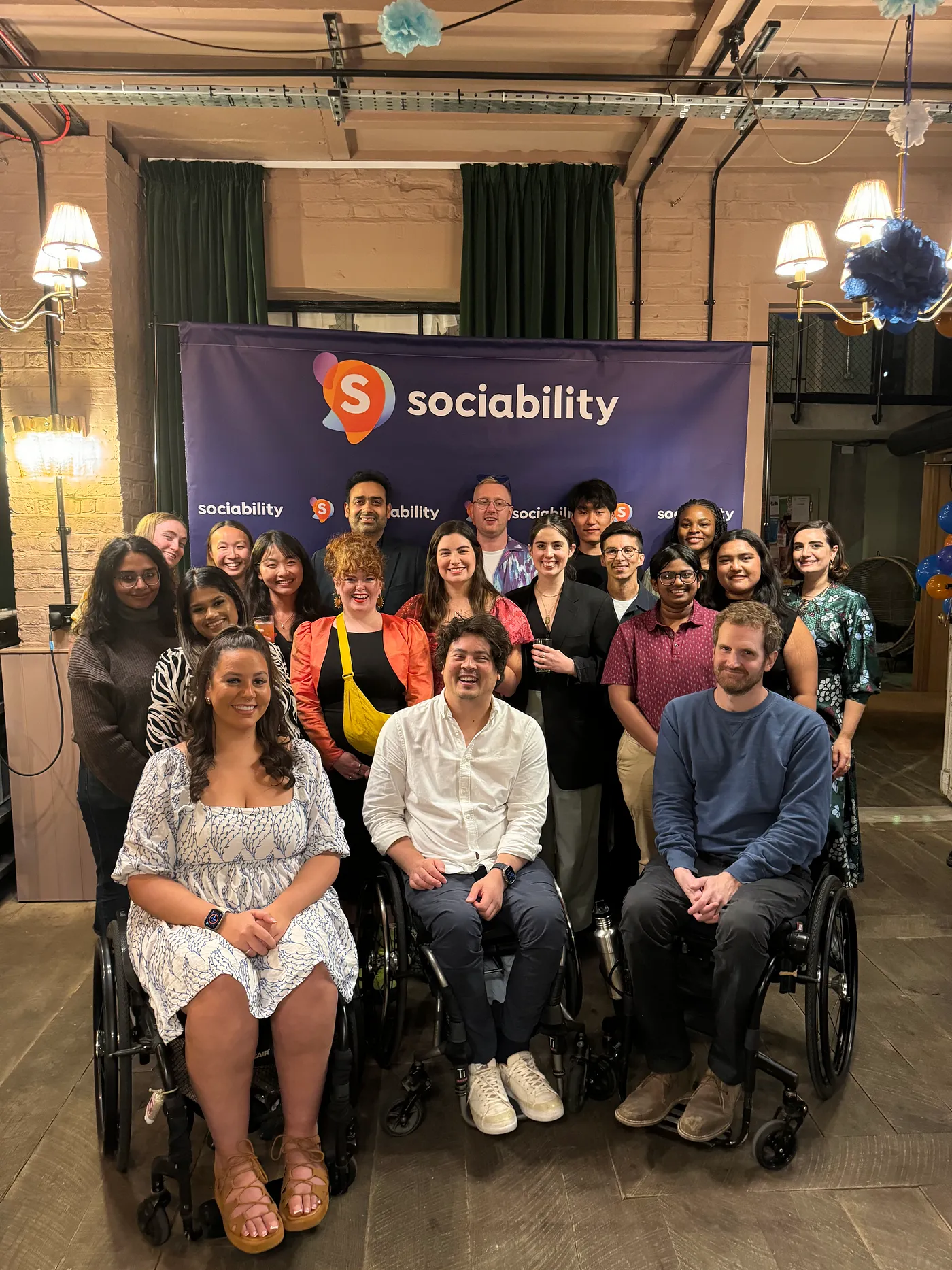
We speak on an indoor balcony as a function room behind us buzzes with activity. About 150 people are packed into a dimly lit room with mood lighting and green ornate curtains. There are name badges and folk chatting over tables of beers. Aside from dozens of wheelchairs and the odd assistance dog, you might think this an unremarkable post-conference gathering. In fact, it is the only social event that’s been organised around Naidex.
Its organiser Matt Pierri, 34, is the founder of an app called Sociability—a software like Google Maps or Waze for people with accessibility needs.
Overcoming the funding hurdle with the Growth Impact Fund
Some 100,000 people used the free platform last year for detailed information about things like accessible toilets, lighting, and noise levels in cafes, bars, and restaurants. The idea is to help individuals plan visits with confidence, with real-time updates as well as a range of list views and filters.
“We have in society this very thin but depressed view of disability,” Pierri says. “We can’t imagine the disabled person going to the cinema or going to a bar or going to a hotel. We just imagine them as disabled.”
“There’s not many facilities for disabled people to have fun,” Jackson says. “For someone to come forward and do an event like that, it’s actually really special.”
And it does feel special. I arrived at the party knowing next to nothing about things like accessibility or inclusive language. As people I speak to describe the ignorance of ‘normal’ people, I quickly realise they are also describing me.
\
\
“There’s not many facilities for disabled people to have fun,” Jackson says. “For someone to come forward and do an event like that, it’s actually really special.”
And it does feel special. I arrived at the party knowing next to nothing about things like accessibility or inclusive language. As people I speak to describe the ignorance of ‘normal’ people, I quickly realise they are also describing me.
Oxfordshire-based couple Soph Gribben and Brennan Wiffen work as an engineer and a scientist. They are kind, patient and articulate as I fumble through questions about their impressive jobs and wonder aloud how common it is for both parties in a relationship to be wheelchair users.
Wiffen explains disabled people are routinely underestimated. The 27-year-old is a trained first aider but a colleague once rejected his help because he uses a wheelchair.
“I was a little bit taken aback,” he says. “I didn’t realise [my wheelchair] would have such an impact on the way people perceive my ability to help others.”
“It’s also just that perception [that] disabled people aren’t capable,” Gribben adds. “Or they don’t realise that actually we’re really good problem solvers, really adaptable and really resilient. That actually lends well to a lot of careers.”
So how do things change? How do we make it easier for disabled people to attend events like this one and increase understanding and awareness of accessibility issues in wider society?
Two threads run through the conversations I have at the party. The first is summed up by Tooke’s New Street Station experience. It is perhaps the most obvious: more accessible spaces, better infrastructure and action from a government whose recent rhetoric on disability has focused on benefit cheating and the abuse of things like the Mobility Scheme and Personal Independence Payments.
The second, as Tooke explains, is harder to fix, because it requires able-bodied and ignorant people (like me) to “start listening” to those who are disabled.
“In my everyday life it’s people’s attitudes that affect me loads more than physical barriers,” she says.
“That is what bogs me down and what makes me frustrated far more.”
While I might not have known exactly the right questions to ask, it seems most people aren’t interested in confronting them at all.
How the Growth Impact Fund helped Sociability
The Growth Impact Fund (GIF) led Sociability’s £1.8 million equity raise as the cornerstone investor, committing £500,000 at a critical moment when the round risked stalling with many small investors, but no clear lead. Beyond capital, the GIF signalled strong confidence in Sociability founder Matt Pierri, the business model and impact, as well as hands-on legal, governance and coordination support, including pro-bono legal assistance, to bring a complex round with multiple smaller investors to a close.
The GIF also accelerated co-investment by sharing due diligence with partners such as Treebeard Trust and Trust for London, and added value through its networks by connecting Sociability to disability expertise from Scope and pro-bono market validation from facilities teams at Bank of America and Macquarie, helping position the company for its next phase of growth.
The “Growth Impact Fund” is managed by Big Issue Invest Fund Management Ltd (BIIFM). BIIFM is the alternative investment fund manager (“AIFM”) of the Fund and is authorised and regulated by the Financial Conduct Authority (FRN: 610618) as a “small authorised UK AIFM” in accordance with article 3(2) of the AIFMD to manage unregulated AIFs. The fund is addressed to professional investors only. Please note that: past performance cannot be relied on as a guide to future performance. The capital of Investors in the Fund is at risk. Any target is not a predictor, projection or guarantee of future performance.